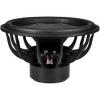
2. More xmax means more SPL
Subwoofers really can be broken down in two categories: Mass controlled drivers and Compliance controlled drivers. Mass controlled tends have low xmax and high sensitivity. These tend to be punchy and very loud and mostly used in live concerts for sound reinforcement or even car SPL competitions. Compliance controlled subwoofers which tend to be the majority of home and car audio subwoofers. They have high xmax, more weight, lower sensitivity, but more SPL in the lower frequency spectrum. Any woofer in these categories can perform well or poor but it largely depends on the required bandwidth. Using a low xmax woofer for subsonic content is probably not ideal and will not only cause distortion but it won’t be efficient. Likewise using a high xmax low sensitivity driver for higher frequencies is not going to be very effective. In truth, there is no one stop solution and most drivers can overlap these areas with good results.
So yes, more xmax does mean more SPL but only for lower frequencies where power is not the limit. Generally speaking, during lower frequencies, the driver tends to run out of usable throw (beyond xmax) before high thermal compression occurs. 0-40Hz is primarily mechanical, 40-60 is in between) 60 and up is going to be thermally limited almost exclusively for most subwoofers. Surprisingly, even the largest drivers with high xmax and big voice coils can be bottomed out or run past a safe mechanical state with only a few hundred watts if the frequencies are low enough. Without a high pass (subsonic) filter, or in a low tuned system, bottoming out or breaking a driver could be a very real possibility without careful modeling and testing.
http://www.data-bass.com/myths